
Electric vehicle (EV) retail sales surged 16.37 per cent year-on-year to 22,70,107 units in 2025, driven by a 77 per cent jump in electric passenger car sales, according to data released by dealers' body FADA on Wednesday. The EV makers had recorded a total sales of 19,50,727 units in 2024, the Federation of Automobile Dealers' Association (FADA) said.

Tata Motors' commercial-vehicle (CV) business reported a 48 per cent year-on-year decline in net profit to Rs 705 crore in Q3FY26, even as profit before tax (PBT) rose 65 per cent to Rs 2,568 crore.

While GST on ICE vehicles was brought down significantly, for electric cars it remained at 5 per cent.

Passenger vehicle (PV) sales growth in India is expected to moderate to 3-5 per cent year-on-year (Y-o-Y) in financial year 2027 (FY27) due to a high base and preponed replacement demand, according to a report released by India Ratings and Research on Thursday.

Tata Motors (TaMo) is aiming to gain market share across its passenger vehicle (PV) and commercial vehicle (CV) businesses - targeting a 40 per cent share in CVs and a 16 per cent share in PVs by 2027. Meanwhile, it has already achieved earnings before interest, tax, depreciation, and amortisation (Ebitda) breakeven in its electric vehicle (EV) business at 1.2 per cent (up 830 basis points), ahead of its target of 2025-26 (FY26).

Retail sales of vehicles across categories in India in 2025 grew by 7.71 per cent at 2,81,61,228 units as compared to 2,61,45,445 in 2024, with GST 2.0 helping overcome a subdued start to the year, Federation of Automobile Dealers Associations said on Tuesday.

Electric vehicle (EV) sales in India rose 28.60 per cent to 1,80,238 units in June over the period year-ago, driven by massive jump in e-passenger vehicle volumes, Federation of Automobile Dealers' Association (FADA) said in a statement on Tuesday. Electric passenger vehicle sales, as per FADA data, stood at 13,178 units in the previous month compared to 7,323 e-PVs in June 2024, registering a sharp increase of 79.95 per cent year-on-year.

Tata Motors is hoping to beat its target year of 2030 and have 30 per cent of its portfolio comprising electric vehicles (EVs), according to Chairman N Chandrasekaran, who was speaking at the company's last annual general meeting (AGM) ahead if its demerger.

The country's largest listed auto parts company by market capitalisation, Samvardhana Motherson International, reported a better than expected operating performance in the second quarter (July-September) of 2025-26 (Q2FY26). Though the global passenger vehicle (PV) market is facing multiple headwinds, the company is outperforming on the back of higher content per vehicle and market share gains.

Auto majors Maruti Suzuki, Tata Motors and Mahindra & Mahindra reported robust sales in September as reduced price tags owing to GST rationalisation led to record demand in the Navaratri period. The month also saw Tata Motors and Mahindra & Mahindra settling at number two and three positions, respectively in vehicle wholesales ahead of Hyundai Motor India.

Tata Motors will soon submit a detailed report on the upcoming manufacturing plant in Tamil Nadu's Ranipet district and a decision, on whether the facility will churn out passenger or commercial vehicles, will be taken by the company on the basis of market trends, state's industries minister TRB Rajaa said on Thursday. "They are keeping the options open, and market trends will determine it (the type of vehicles the plant will make). "They will quickly come up with a detailed report on that," Rajaa said.

Automotive (auto) major Tata Motors posted a 51 per cent drop in consolidated net profit for the January-March quarter (Q4) of 2024-25 (FY25), to Rs 8,470 crore, due to a deferred tax asset of almost Rs 9,000 crore in the corresponding quarter of the previous financial year and an exceptional item of Rs 566 crore during the quarter. Revenue was up just 0.5 per cent year-on-year (Y-o-Y) at Rs 1.18 trillion for Q4FY25.
Automobile giant Tata Motors' shares were in demand on Wednesday as the stock rallied as much as 3.69 per cent to hit an intraday high of Rs 671.80 per share, before settling 3.18 per cent higher at Rs 668.45. By comparison, the BSE Sensex settled 0.10 per cent, or 72.56 points, lower at 74,029.76.
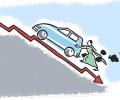
The only silver lining in March's performance -- which otherwise dragged down the financial year's momentum -- was a 6 per cent year-on-year (Y-o-Y) growth compared to March of the previous year. This is largely due to incentives, festival-driven gains, and new launches.

Automobile retail sales grew 9 per cent year on year in 2024 riding on the back of robust demand for two-wheelers and passenger vehicles amid challenging business environment, dealers' body FADA said on Tuesday. Overall vehicle registrations stood at 2,61,07,679 units last year as compared to 2,39,28,293 units in the 2023 calendar year, recording a growth of 9 per cent.

There is no impediment to normal operations as Tata Motors puts in place the demerger process of its commercial and passenger vehicles businesses. Instead, the demerger would provide greater manoeuvrability for both new entities to operate independently, according to Tata Motors management. While there may not be immediate value unlocking, it will give investors clarity about future growth and the financials across different segments.

'Wherever the government has provided incentives for the purchase of two-wheelers, three-wheelers, cars, buses, and trucks, it gets a push for most of these alternate fuels. '

'This market for diesel starts at around Rs 6.3 lakh and goes up to Rs 7 lakh, and with Saathi we have our usual price set at Rs 6.5 lakh, so we are slightly on the lower side with a superior product.'
Tata Motors is likely to exit the S&P BSE Sensex and the Nifty50 indices once the demerger process of its commercial vehicle (CV) and passenger vehicle (PV) businesses is complete, analysts at Nuvama Institutional Equities said. They have compared the development with Reliance Industries (RIL) and Jio Financial Services, which got listed separately and eventually (in the next few days) got excluded from the domestic indices.

Notwithstanding robust volume growth and a strong performance from Jaguar Land Rover (JLR), Tata Motors, the country's second-largest automobile (auto) manufacturer by market capitalisation, disappointed the Street with its January-March quarter (Q4) results for 2023-24 (FY24). While consolidated revenues saw a 13 per cent increase, lower-than-expected realisations in the Indian operations weighed down overall performance.

Electric vehicle sales registered a 55.2 per cent on-year growth at 1,79,038 units in July driven by a massive 96 per cent jump in e-two-wheeler sales, automobile dealers' body FADA said on Tuesday. The total electric vehicles sales for July 2023 were at 1,16,221 units, according to the monthly sales data from Federation of Automobile Dealers' Association (FADA).

Automobile (auto) retail sales in India grew by an impressive 14 per cent in July compared to the same period last year, driven by a surge in the rural economy, good product availability, and product launches. While passenger vehicles (PVs) saw a 10 per cent increase during this period, inventory levels have surged to a historic high of 67-72 days in PVs, equating to Rs 73,000 crore worth of stock, according to the Federation of Automobile Dealers Associations (Fada). This poses a risk to dealer sustainability. Inventory levels in July 2023 were only 50-55 days, equating to a stock worth Rs 49,833 crore. In June 2024, inventory was between 62 and 67 days, with a stock value of Rs 60,000 crore.

Eicher Motors is a leader in the premium motorcycle segment, where it holds market share of over 85 per cent under the Royal Enfield (RE) brand. The company's joint venture VE Commercial Vehicles (VECV) with Volvo, where it holds 54.5 per cent stake, gives it a strong footing in commercial vehicles (CVs). The company had good results in FY23 and it has a strong balance sheet and good operating margins.

Tata Motors surpassed Maruti Suzuki (India) (MSIL) to become the most-valuable automobile company, in terms of market capitalisation (mcap), after a gap of seven years. With this, the company's stock hit a new high on the BSE on Tuesday (January 30). The combined mcap of Tata Motors (Rs 285.51 crore) and Tata Motors DVR (Rs 29,119 crore) stood at Rs 3.146 trillion.

'In April, we saw a 10 per cent growth in our own volumes.'

Auto Expo 2023 may not trigger a fresh rally in automobile stocks, say analysts, as this year's edition lacks participation from major listed players. It is also owing to the focus on electric vehicles (EVs), a segment where four-wheelers have minuscule market share. "In the passenger vehicles (PV) segment, Maruti Suzuki India and Tata Motors are the only listed players.

Bajaj Auto's market capitalisation (market cap) hit Rs 2 trillion mark for the first time. The stock of the two and three-wheeler major rallied 6 per cent to hit a new high of Rs 7,420 on the BSE in Tuesday's (January 9) intraday trade after its board approved Rs 4,000 crore share buyback at Rs 10,000 per share. The stock ended the day at Rs 7,093.75, up 1.55 per cent and its market cap a shade above Rs 2 trillion.
After clocking losses for seven straight quarters, Tata Motors on Wednesday posted a consolidated net profit of Rs 3,043 crore in the third quarter (Q3) of 2022-23. This came on the back of a strong order book, better semiconductor chip supply, tempered commodity prices, and a better product mix. "We remain cautiously optimistic about the demand situation, notwithstanding the global uncertainty.

Auto mobile retail sales in India witnessed a 10 per cent annual growth in July driven by robust sales across passenger vehicles, two-wheelers and commercial vehicles, industry body FADA said on Monday. Total retail sales across segments rose to 17,70,181 units last month, as compared to 16,09,217 units in July 2022. Passenger vehicle sales saw an increase of 4 per cent to 284,064 units last month, as compared to 273,055 units in the year-ago period, the Federation of Automobile Dealers Associations (FADA) said in a statement.
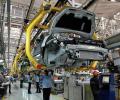
Automobile manufacturers are likely to report strong numbers for the September quarter of Financial Year 2023-24 (Q2 FY24), riding on growth across segments and offset by a marginal drop in overall two-wheeler (2W) volumes. Higher average selling price (ASP) year-on-year (YoY), which was necessitated by price hikes taken by original equipment manufacturers (OEMs), and an improved product mix will also aid revenues and margins. Moreover, commodity prices are down on a YoY basis, leading to higher margins in earnings before interest, taxes, depreciation and amortisation (Ebitda).

Corporate India is starting to step up its capital expenditure plans amid government incentives and signs of rising demand, company executives and analysts have indicated. This coincides with the Reserve Bank of India (RBI) recently citing a double-digit growth in private capital expenditure. Healthy balance sheets of banks and corporates, along with increasing capacity utilisation and improving business sentiment, are contributing to a favourable environment for sustained growth in private sector investments, the RBI said in its policy last week.

Auto industry volumes have grown by 2.5 per cent overall, led by domestic sales of three-wheelers, two-wheelers and passenger vehicles (PVs) in the first quarter of this financial year. Analysts predict an 18 per cent growth in revenues for automotive original equipment manufacturers (OEMs) and profit growth of 69 per cent year-on-year (YoY). However, on a sequential basis, a decline in revenues as well as earnings before interest, taxes, depreciation, and amortisation (Ebitda) margins is expected.

'In FY23, PV sales are expected to end the year at a record 3.8 million units, up 26 per cent. In FY24, however, the industry is expecting 5-7 per cent volume growth'

With the theme 'Smart Mobility, Smart Cities', the company's display at the Auto Expo is focusing on intelligently-connected cities designed to offer convenience, safety, security, and efficiency to its customers.

'Favourable product mix, sales recovery, and cost saving initiatives are expected to support margins going ahead while focus on debt reduction (target of debt free by FY24) will aid balance sheet strength'
Retail sales of overall vehicles in India grew by 15.28 per cent to 2,11,20,441 units in 2022 led by record sales of passenger vehicles and tractors, Federation of Automobile Dealers Associations (FADA) said on Thursday. In 2021, total retail sales of vehicles in India were at 1,83,21,760 units, FADA said in a statement. Two-wheelers retail sales stood at 1,53,88,062 units last year, a growth of 13.37 per cent from 2021 when sales stood at 1,35,73,682 units.
Retail sales of passenger vehicles grew last month but the sales of two-wheeler and commercial vehicles remained low compared to the pre-COVID month of May 2019, according to automobile dealers' body FADA. On Monday, FADA said that overall auto retails stood at 16,46,773 units in May, down from 18,22,900 units in May 2019. "May 2022 retails when compared to May 2019 reveal that sales are still not on a growth trajectory as overall retails were down by 10 per cent.

Signals received from the government in the past one year reflect a state of utter confusion, says Abhishek Tripathi.

Maruti will showcase its first concept electric vehicle, the e-SURVIVOR; M&M it's six new EVs, including two futuristic concepts
Automobile retail sales in the country fell 18 per cent year-on-year in the 42-day long festive period this year as semiconductor shortage impacted production across companies affecting their ability to supply adequate numbers to dealer partners, FADA said on Thursday. During the period under review, barring three-wheeler and commercial vehicles, all other segments including passenger vehicles, two-wheelers and tractors were down as compared with the same period of last year. As per data collated by the Federation of Automobile Dealers Associations (FADA), total retail sales across segments stood at 20,90,893 units this festive period, down 18 per cent from 25,56,335 units in 2020.
 © 2026 Rediff.com - Investor Information - Advertise with us - Disclaimer - Privacy Policy - Sitemap - Feedback - About us - Terms of use - Grievances